For MILTON Magazine this month, we asked Rachel to reflect more on how this beautiful art project came to be. We are grateful for her reflections:
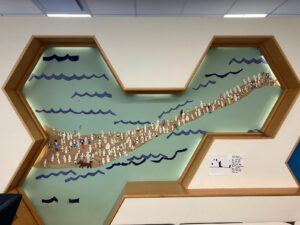
“The idea for this project grew from a desire to build off of the Purim paper people project, where each Elementary School student decorated a small paper person using the prompt: “What makes you brave like Esther?” Their creations decorated a miniature Shushan in the lobby, and then for Passover, the same figure crossed through a parted sea on the wall.
What was powerful about the Purim project was that the form really did seem to give the kids a certain kind of access to imagining themselves in the context of the story, and in particular, the characters Mordechai and Esther. It was also playful, and at a scale which tends to be really evocative for kids. Students LOVE making little worlds in art class and placing their people in different scenarios, and our tradition gives us a lot of material for creating a backdrop for those. That’s where art has a lot of power to be a portal for our students. The thoughts they have, and the connections they make to these themes through their art, are extremely moving to me.
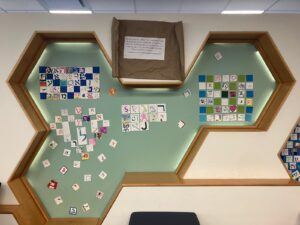
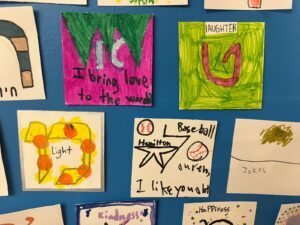
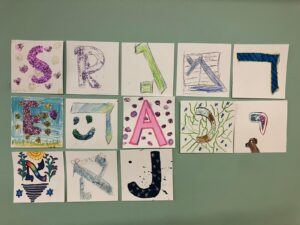
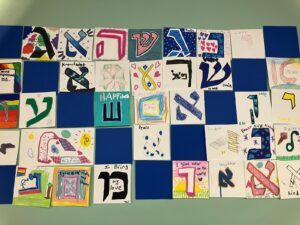
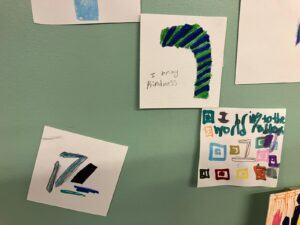
So when we wanted to think of a way students could reimagine themselves at Mt. Sinai, Reb Scott and I had the idea of using letters. We were drawing from an idea that each of us is a letter in the Torah, and as such all have something to give the world and are all required to achieve wholeness as a people. So each of the students were tasked with picking a letter, decorating that letter, and expressing what it is they give, or want to give. The students had access to ink, quills, and whatever other mark making material they wanted, and referenced books, printouts, and other examples of Hebrew calligraphy. Many students took the form of their letters very seriously, and studied the various Hebrew calligraphy books, made drafts, and really focused on traditional forms.
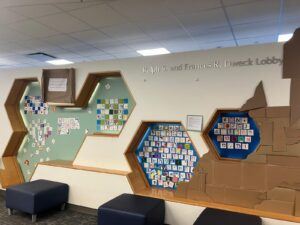
Students in my collaborative art chug arranged the tiles on the wall, and some decided that they should be more dynamic and less tile-like. I love when the students make design choices like this, and learn a lot from them. I may have an idea of how something should look, but ultimately I want it to be theirs – for them to feel ownership, pride, and agency, and to have our support in getting there.
In terms of process, one thing I noticed was that given the opportunity, kids want to find themselves in whatever thing they are doing, make it theirs, and also use it as an opportunity to communicate with others something about themselves. Sometimes I see reflections of things I already know about the students and sometimes things are revealed to me, and perhaps to the students, in that process.
My hope is always for kids to find meaning and connection in the work that they are doing, and also to experience art – the making but also the generative act of sharing as an individual and a collective – as a very powerful and unique process. When I see the lobby as a public art space, and see kids rearranging and reimagining their work in it, I am reminded that this is an act of co-creation – that we’re doing that work of meaning making together. I am a person who learns through doing, and I learn so much each time I do one of these larger scale projects across grade levels. Mostly I learn that students all just want to see and be seen, and that our job is to help them do that in ways that are thoughtful, playful, and even beautiful.”