MILTON’s Report Card: About Our Upcoming Accreditation
June 29, 2026
You might have noticed the word “accreditation” on the 2026-27 school calendar, or perhaps you have heard a reference to accreditation on our professional development days. But what exactly is accreditation, and how is the MILTON community involved with it? Read our Q&A below for more information on this process.
What is accreditation?
The same way that students get annual report cards, and that families attend parent-teacher conferences, it is important for MILTON to be assessed on how we’re doing institutionally. While we see the family survey (and a corresponding staff survey) as our progress reports, accreditation is the report card equivalent.
MILTON gets accredited every 10 years by AIMS, the Association of Independent Maryland and DC Schools. Being accredited means that a school has demonstrated that it is compliant with local standards and policies, is following best practice, and is delivering on its mission to its students, families, and larger community.
Why is accreditation important?
Accreditation is an opportunity for thorough, evidence-based self-reflection and analysis based on our school’s mission, and provides a concrete roadmap for further innovation based on real data. It ensures that each school is continuously growing as an institution in order to best serve its families. Accreditation also serves as a mirror to ensure that we are following best practices or that we take time to implement new practices, procedures or policies to remain up to date and to ensure school continuity and sustainability.
What does the process look like?
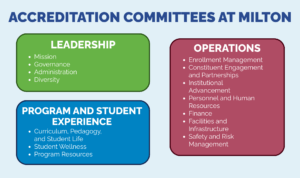
The process begins with a self-study: a community effort to ask and answer questions about how we’re doing and our institutional health. The self study looks at various domains relevant to the institution’s overall health including the school’s leadership, student experience, curriculum, and pedagogy, operations, governance, enrollment management, human resources, and more. MILTON began its self-study in Fall of 2025 and all staff members, as well as MILTON’s Board of Trustees, have been engaged in this process. MILTON’s self-study is due in January 2027.
After the self-study, we will be visited by an accrediting team made of professionals and leaders from other schools. Following the visit, we will receive commendations and areas to focus on for improvement in the form of recommendations in each area of evaluation. In each domain, MILTON will be given one of three scores: Pass, Pass with Mandate (meaning we have to fix one small thing), or Fail (meaning we need to seriously review and adjust practices, policies, or procedures). We will then have one year to write an action plan addressing the recommendations from the accrediting team. Once the action plan is approved, we will be re-accredited, with a follow-up five years later to determine whether we have fulfilled our commitments.
What will the team look for on the visit?
For three days, the visiting accrediting team immerses themselves in life at MILTON to affirm our findings from the self study—essentially, whether the school is actually doing what we say we are doing. They also provide insights on where we excel or where there is room for growth or change. The team will read our report, visit every teacher’s classroom for 10 minutes, and meet with key employees, trustees, students, and parent representatives.
What does the self-study look like? How do staff participate?
We are well into our self-study. During fall 2025, staff began to compile documentation related to everything from budget to curriculum. Beginning in January 2026, staff members were assigned to committees (along with one Board committee) and were asked to review different discussion questions in each domain related to where we are as an institution, our strengths, and areas for growth.
Each question corresponds with an AIMS standard for accredited schools. For instance, one standard in the Curriculum, Pedagogy, and Student Life section is: “The School provides a mission-driven educational program that promotes learning and personal growth.” One of the discussion questions the Curriculum, Pedagogy, and Student Life Committee answered is “Is there appropriate balance among the more academic disciplines, including English, math, science, history, and other content areas defined by the School?” They answer this question for each division of the school, using provided documentation as evidence.