Class of 2026 Art Installation: Illustrating Our Core Values Through Mosaics
June 30, 2026
June 30, 2026
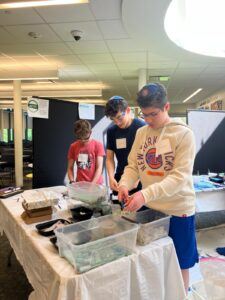
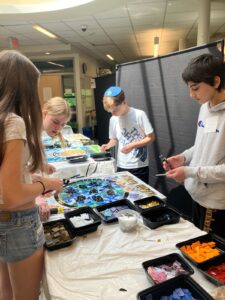
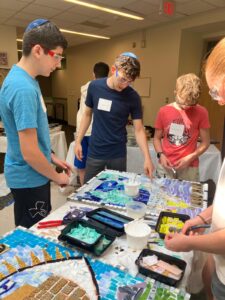
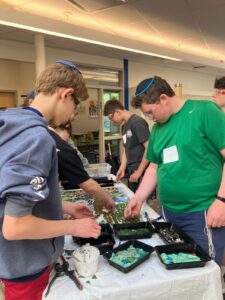
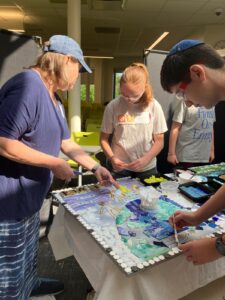
Each year, MILTON’s graduating class creates an enduring art installation to be displayed at school. This year, the Class of 2026 partnered with artist Rena Fruchter, who specializes in creating collaborative mosaics with communities of all sizes. The students split into groups, with each group assigned to one of MILTON’s seven core values. The students worked together to create a design, which Fruchter then transformed into a map indicating what kinds of pieces to place in each area of the mosaic. Fruchter brought a huge supply of glass, stone, and ceramic pieces that the students worked to assemble their final products.
The students then wrote reflections about each of their core values, how they experienced them at MILTON, and how they translated them into their mosaic to be read at graduation. The mosaics will be on display in the third floor hallways leading to the Middle School Commons. Below, view each mosaic and read the reflection about the thought process behind it.
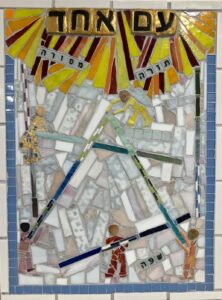
Am Echad (One People)
The value Am Echad stood out to us because we felt it was representative of the community MILTON has provided for us and of what we are leaving behind here. We and our groupmates decided to create an art piece that depicts a diverse group of people working together to construct a Magen David (Star of David). We decided to use these designs in our artwork to represent how Jews of different backgrounds come together as one people, or עם אחד. We found this value particularly resonant on our Europe trip when davening Kabbalat Shabbat in the Alteneushcul, (The Old-New Synagogue) in Prague, which is the oldest synagogue in Europe. There, we were in awe to discover that everyone in the shul—and there were many people from all over the world—knew the same tunes that we did. This made us feel very connected to our Jewish roots and proud of the Jewish identity that MILTON has helped us create for ourselves.
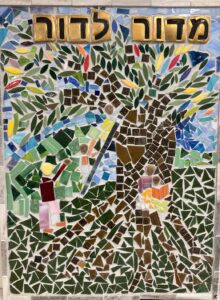
M’dor L’dor (From Generation to Generation)
In our mosaic, we represented an older person reading a book to the younger generation, and a person climbing a ladder, symbolizing the next generation reaching what the past one couldn’t. Throughout our MILTON journey, there have been many cases in which this core value was exemplified. One poignant example of this is Share the Nachas Day. On this day, grandparents come to students’ classes and have the opportunity to learn alongside us. This day is so special and memorable because we are able to learn incredible things with and from the generations prior to ours.
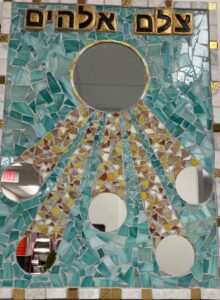
B’Tzelem Elohim (In God’s Image)
Through the years at MILTON, we have been encouraged to see the important spark in each person and to appreciate that everyone is unique in their own way. We have felt seen; our ideas have always been valued, and we have been taught to see others’ perspectives and opinions as different but equal. The idea of B’Tzelem Elokim is very abstract and can mean different things for everyone. Instead of representing humans in our artwork, we chose to use mirrors. By using mirrors, everyone fits into the artwork by seeing their own reflection and their own unique spark. We also included mirror fragments flowing into the circular mirrors to show that each person contributes to the same light.
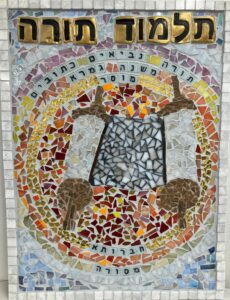
Talmud Torah (Study of Torah)
Throughout our years at MILTON we have engaged in multiple Judaic studies classes and grew up learning the Torah and its values, which helped us have pride in our Jewish identity. We have had a strong relationship with the Torah and different aspects of Jewish life. When we chose to depict the core value Talmud Torah, we found it meaningful to reflect on the years of our learning together and to think together about how to depict that experience in our artwork. For our art piece, we created a Torah radiating light. The colors closest to the Torah are the most bright and concentrated and it fans out in rings, becoming more and more muted as it moves away from the Torah. We did this because we wanted to represent how the closer you are to the Torah, the greater the impact of the learning and experience on who you are.
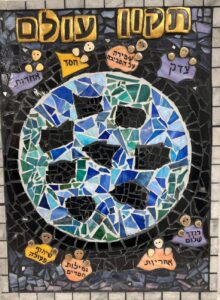
Tikkun Olam (Transforming the World)
Tikkun Olam means repairing the world, and is the idea that we all share responsibility for improving the world around us through our actions. During our years at MILTON, Tikkun Olam became more than just a concept to us, and we began to understand how meaningful it is, even in our day to day lives. Our design represents this important value by depicting a broken Earth with missing pieces, with people around it holding the pieces that are needed to fix it. Tikkun Olam begins with small actions, and we can change the world together. As we leave MILTON, we hope to carry this value with us into high school and beyond.
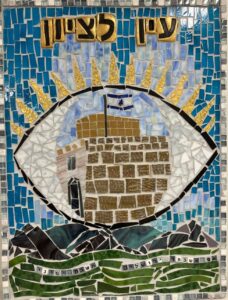
Ayin L’Tsion (Looking Toward Zion)
“If I forget Jerusalem, let my right hand forget how to work.” For our art installation depicting Ayin L’Tsion, or “Looking Toward Zion,” we created an image of Jerusalem inside an eyeball to show how we, as Jews, are constantly thinking of Israel, and our connection to it. We depicted the old city walls as the centerpiece of the mosaic, since the Kotel (the Western Wall) is the spiritual center of Jewry around the world and where we turn towards when we pray. Although our grade did not go to Israel this year, we had a full unit on it in our Hebrew curriculum, where we dove deeper into Israeli geography, history, and culture. In addition, we have a weekly class studying Israeli history throughout middle school. This is just a small sample of how much MILTON connects us to the land and people of Israel, which we expressed through our mosaic.
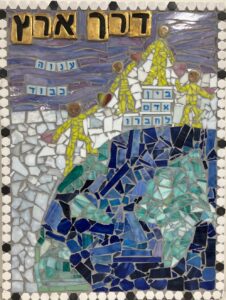
Derech Eretz (Thoughtful Conduct)
Throughout our time at MILTON, we have learned how to incorporate derech eretz into our daily lives. Derech eretz means to have kindness, respect, and honor toward one another. In our mosaic, we represented a globe with people standing above it holding hands and connected by hearts. We highlighted the Hebrew words and terms of anava, being humble, kavod, respect, and ben adam l’chaveiro, which relates to the mitzvot that can be done to have positive relationships with others.