250 Words and a Prayer: Grade 3’s Celebration of the United States
July 2, 2026
July 2, 2026
How do you tell the story of a nation in only 250 words? This is the question Grade 3 students and their teachers considered all year long as they embarked upon a project never done before at MILTON: commemorating the United States’s 250th birthday as part of their yearlong state project.
The Grade 3 state project is one of MILTON’s longest running traditions. During the first week of school, each student in the grade is assigned a state that they will study throughout the year. Students research the state’s history, geography, and culture. They interact with park rangers from their states to learn about their National Parks, study famous figures, and dive into the indigenous people of their regions. They integrate their studies of the states into every other part of their learning; for example, they learn to write their first paragraphs while compiling research books, and learn to count money by collecting state quarters for a tzedakah project. At the end of the year, students display their research at the Travel Fair, where parents and other students visit their detailed, elaborate exhibits.
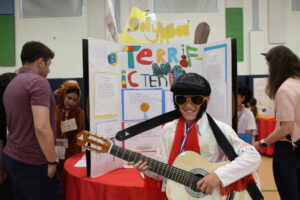
A student poses at the 2026 Travel Fair.
This year, the Grade 3 teachers sought to add another layer to their study of the states through an interdisciplinary art project that would last as a permanent installation on campus. They aimed for this to be a collaborative project, working with campus art specialists, Hebrew, General Studies, and Judaic Studies teachers to weave in themes from each class. As a team, they landed on a final project: creating an image of the United States in the style of micrography.
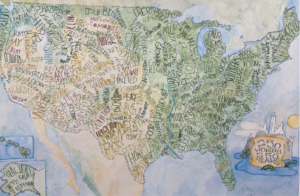
Micrography is the practice of creating images out of small written words. It originated in Jewish communities in the ninth century and used Hebrew letters to form designs. In this case, the students’ General Studies teachers guided them in generating five words each representing their individual states. Together, this resulted in a collection of 250 words representing 250 years of the United States. When displayed together in the form of a U.S. map, these words would collectively tell the story of our land.
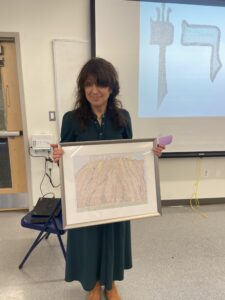
North Campus principal Lisa Schopf led a lesson introducing students to micrography.
To generate words, students considered each state’s geography and wildlife, history, culture, industries, and more. They examined symbols of their states, connecting them to values that link people inside and outside of them. Some chosen words are quite specific to their states, but others are broader and may apply to multiple states at once. Thus, in telling a full story of their states, the students created a collection of words that represent the United States in its broadest and most specific forms.
Some words represent parts of state culture like jazz, bluegrass, baseball, and horseracing. Others represent natural features like redwoods, petroleum, grizzly bears, and beaches. Still more represent the people and histories of the states: explorers, legislators, artists, families, battlefields, farms, and factories. Some of the broadest words represent the concepts and values that students felt represented their states: rights, growth, amazement, discoveries, and generosity. And the students were nuanced: words like “destruction” and “conflict” can be found in the map as well, creating a multifaceted portrait of our country’s long history.
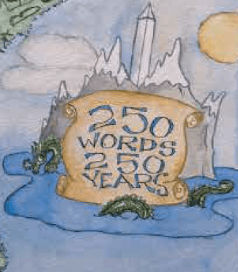
During art class, students worked with art specialist Rachel Bickel to create mock-ups of the final map. At the very end of the process, staff member Mat Tonti added a cartouche, a feature used to frame the titles of ancient maps. The title of this map, “250 Words, 250 Years,” is framed by seas, skies, and mountains, representing each Grade 3 class.
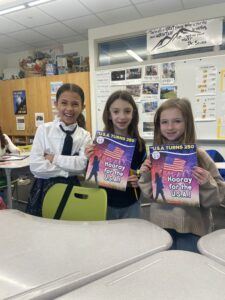
Students complete an activity for their state projects.
Students also worked with their Hebrew teachers to translate one of their five words into Hebrew; each student’s chosen Hebrew word appears on the map as well. Many students did not yet know their translated words and got to add them to their emerging Hebrew vocabulary, bringing another layer of learning to this project.
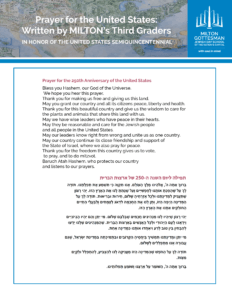
As the final part of their project, students also wrote a prayer for the United States. This was the culmination of the students’ studies of the origins and structure of prayers in their Netivah (path) programming, where students participate in rotating educational programming that focuses on different aspects of tefillah. As part of their learning, the students reflected on what types of words and thoughts can be part of a prayer and the functions and meanings one might have. They composed original prayers throughout the year, and then, after studying the Prayer for the State of Israel and Prayer for the United States, came together to write one as a class that honored America’s 250th birthday.
As a grade, the students brainstormed with their Judaic Studies teacher, Ora Cohen-Rosenfeld, on the opening line of the prayer. After writing the opening line together, Ora asked each student to write one sentence they felt should be included. The final prayer you read today is woven from these sentences, reflecting the students’ aspirations for the United States.
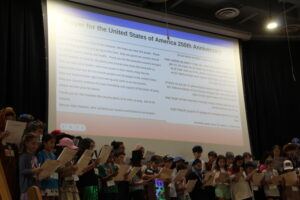
Students read their original prayer at the Travel Fair.
At the start of the students’ Travel Fair in June, they debuted both the map and the prayer for families, peers, and staff. The map will now become a lasting display in the downstairs classroom hallway of North Campus, serving as a reminder of the teamwork and meaningful learning that took place throughout this entire project. As Head of School Deborah Skolnick-Einhorn told families when introducing this project, “This map is more than an image of the United States. It is a portrait of curiosity, learning, creativity, and community. It reminds us that a nation’s story is not told by landmarks alone, but by the people, ideas, values, and dreams that share it.”
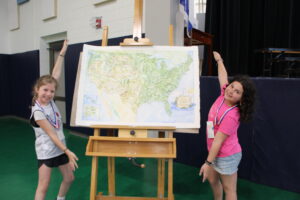
Students stand with the map at the Travel Fair.